Union of Skills - The importance of student internships abroad for Erasmus+ in Cottbus
Two half-days | a wealth of insights
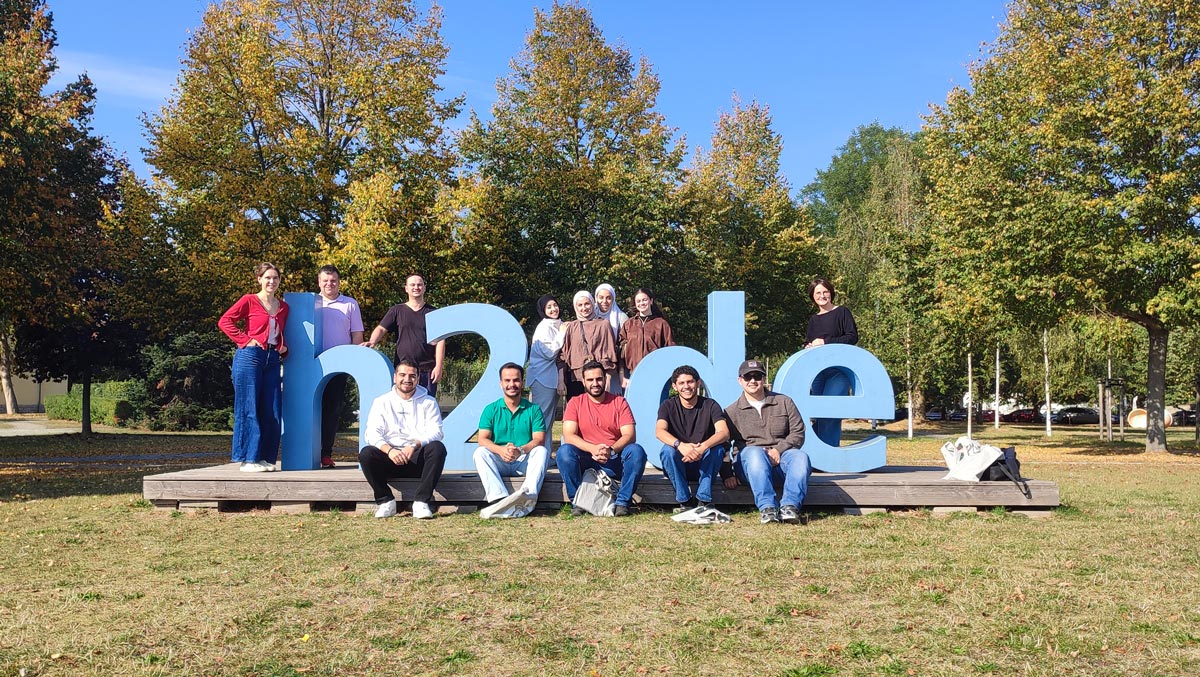
On 10 and 11 March 2026, the Brandenburg University of Technology Cottbus-Senftenberg and the NA DAAD hosted a meeting for internship coordinators and mobility consortia.
“We clearly didn’t have enough time to discuss all the ideas and potential solutions for our real-world case studies. There could hardly have been a better sign for our workshop on ‘Criteria and measures for quality assurance in compulsory work placements’,” says Lisa Westphal, our Corporate Relations Manager at the GJU Project Office.
At the Erasmus+ conference in Cottbus, Lisa Westphal was present in person, whilst Magdalena Riedler, Internship Coordinator in the IAD’s Internship Team at the German Jordanian University, participated online. During their workshop, they were able to engage in an in-depth discussion of different approaches and solutions, using specific case studies as a basis. The focus was on challenging situations arising from the compulsory internships undertaken by students at the German Jordanian University (GJU) – from both the employer’s and the student’s perspective.
“We presented the internship cycle as we are jointly developing it within the GJU’s transnational education project: from requirements and preparation, through the search for an internship and supervision, to problem management and the final feedback following the work placement,” explains Lisa Westphal. Various departments, such as the IAD with its Internship Team, and different roles, such as those in student and corporate relations, are involved in this process.
“It became particularly exciting when we delved into real-world examples – scenarios that we actually deal with on a regular basis at the GJU project office and within the GJU internship team in Jordan.”
In many of these situations, there is no single correct solution or perspective. The participants therefore took on different roles in small groups:
How would you solve a student’s problem as a Student Relations Manager? Who would you need to involve in your decision? And how does the perspective change when the Corporate Relations Manager views the situation from the company’s point of view? A change of perspective opens up new approaches to solutions and can be particularly effective when problems initially seem unsolvable.
Lisa Westphal was able to gain valuable insights from the other presentations at the event, including Maarten Brand’s talk on ‘Inclusion, Diversity and Accessibility in Erasmus+ Placements’. ‘This has shattered a few “glass ceilings”, particularly regarding the impact of certain wording in call for applications.’ On the one hand, the degree is important as a qualification; on the other hand, well-founded competencies that reflect specific skills should also be highlighted.
She also found the presentation by Ilona Scherm and Fanny Metál on maintaining corporate networks particularly interesting. Among other things, this focused on companies’ perspectives regarding dual-study students who wish to undertake an internship at another company whilst studying abroad. Students bring new perspectives, methods and best practices from abroad, which can lead, amongst other things, to new contacts with companies, universities or research institutions. Students can also help to raise a company’s profile and enrich it with different processes, innovative approaches or new technologies.
The day was brought to an inspiring close with a group visit to the Brandenburg State Museum of Modern Art – Dieselkraftwerk. The exhibitions – including *Radical Beauty / Radikale Schönheit*, *jama: pśichod / Grube: Zukunft* by Karoline Schneider, and *Gemachte Männer – Körper, Gestus, Habitus maskuliner Bildwelten* – offered fascinating perspectives and plenty of scope for discussion beyond the conference topics. The differing interpretations of the artworks symbolised the various perspectives that we incorporate and take into account with regard to problem management during the practical phase of the GJU students’ studies.
The GJU Project Office would like to thank everyone involved for the open dialogue, the wide range of perspectives – and the inspiration for our future work in the field of international internships.

-Adnan-Bilbeisi_website.jpg)