Transnational Education: Responsibility, Prospects, Science Diplomacy and Alumni Engagement
From 13 to 15 April 2026, the DAAD Conference on Transnational Education (TNB) took place in Berlin under the title “Responsibility and Prospects: Transnational Education Programmes in an International Comparison”.
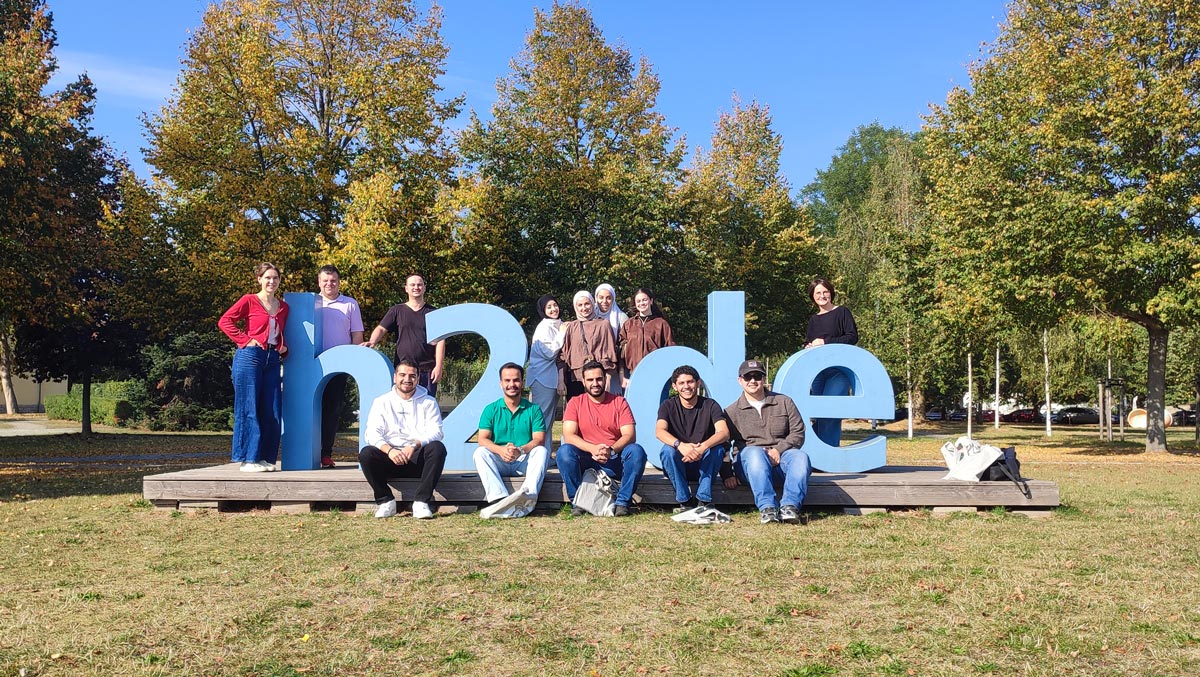
This year’s conference brought together international experts, university leaders and programme managers to discuss the future of global scientific cooperation. The GJU project office at Magdeburg-Stendal University of Applied Sciences (h2) was also represented.
“The DAAD’s high-level TNB conference made one thing abundantly clear to everyone: The German-Jordanian University (GJU) is one of the best education and research projects in the world. As a university, we can be proud to host this project management, to continue supporting the GJU and thus to be part of an increasingly important field of science diplomacy,” said Manuela Schwartz, Rector of h2 and Project Manager of this TNB project and the associated GJU Project Office. This office supports the German dimension of the GJU.
Worldwide, the BMFTR currently supports seven binational universities and one university centre in collaboration with the DAAD, and also funds more than 300 degree programmes with German participation. The spectrum ranges from engineering and economics to programmes in artificial intelligence and media literacy.
These include Magdeburg-Stendal University of Applied Sciences, home to the GJU Project Office, and the German Jordanian University (GJU).
Spotlight on the GJU Project Office’s alumni work & food for thought
As part of a spotlight session, Student Relations Manager Marie Dierck and Project Coordinator Ruth Pappenhagen, together with GJU alumna Reqqa Salem, presented the GJU Project Office’s Alumni Ambassador Programme.
“I was particularly pleased to have the opportunity to provide insights into my work as Student Relations Manager in the field of alumni management. This primarily involves acting as the central point of contact between alumni ambassadors, students and partner organisations, as well as the operational management, coordination and continuous development of the Alumni Ambassador Programme.
I found the subsequent discussion with the audience particularly engaging, as it offered valuable food for thought on issues of autonomy and self-organisation within alumni networks, as well as on global alumni structures within transnational education projects,” notes Marie Dierck following three intensive days of the conference.
Impressive CVs made possible by transnational education Projects
In his address, BMFTR State Secretary Dr Rolf-Dieter Jungk highlighted one such outstanding CV. Joud Odeh studied at the German Jordanian University. Through a curricular exchange semester in Germany, she found her way into an interdisciplinary Master’s programme in Life Science Informatics at the University of Bonn. She conducted research into Alzheimer’s diagnostics and now works in the life sciences sector in Lower Saxony.
“When countries learn together, more than just knowledge grows. Our innovative strength grows – our collective innovative strength,” said Dr Rolf-Dieter Jungk. Our capacity for cooperation also grows. And with it, so does the chance of a future of peace, freedom and prosperity.
Transnational education and cooperation are all the more important in times of Crisis
The conference highlighted the vital contribution that transnational education projects make in current social and political contexts, particularly in times of crisis.
In his address, State Secretary Dr Rolf-Dieter Jungk of the Federal Ministry for Economic Cooperation and Development (BMZ) also spoke of geopolitical challenges: “I shall mention only the most important ones. Feeding the growing world population, managing our natural resources, protecting the environment and, above all, finding solutions to climate change. We are placing great hopes in new technologies, but also in the humanities and social sciences, to overcome these challenges. For education and research have always been the engines of progress. Now more than ever, this is what matters.”
“Higher education ‘made in Germany’ is in demand worldwide,” said Dorothee Bär, Federal Minister for Research, Technology and Space. “Alongside geopolitical changes, we are currently witnessing intense competition for talent from all over the world. At the same time, the global demand for high-quality higher education is growing. Transnational education is an important tool for Germany. It enhances the international visibility of our excellent universities, creates local educational opportunities and opens up new pathways for skilled professionals. This fosters sustainable cooperation from which both Germany and our partner countries benefit in the long term.”
DAAD President Prof. Dr Joybrato Mukherjee adds:
“Transnational education has been a hallmark of German higher education institutions for more than two decades. Together with our partners worldwide, we create study programmes that combine academic excellence with regional needs. Programmes that enable German degrees to be obtained in Vietnam or provide practice-oriented training with a German focus at the ‘German-Jordanian University’ demonstrate the lasting impact of our cooperative approach. Particularly in times of global upheaval, we are thereby strengthening Germany’s academic networks, training skilled workers and contributing to the resilient development of higher education systems worldwide.”
The GJU has been highlighted on several occasions as a best-practice example, particularly for its successful combination of academic cooperation and intercultural dialogue.
As a strategic partner of the GJU and the location of the GJU project office, Magdeburg-Stendal University of Applied Sciences is deeply committed to further promoting this international cooperation. In doing so, it remains an active part of a living science diplomacy that builds bridges across national borders between education, research and mutual understanding.


%20David%20Ausserhofer.jpg)

-Adnan-Bilbeisi_website.jpg)